
Why Your Privacy Initiative Isn't Getting Traction: A Communications Perspective

Guest Contributor
Gab Ferree
Founder, Off The Record
Gab Ferree is the founder of Off The Record, a private membership community for communications professionals with members from companies like Netflix, Atlassian, Paramount, Splunk, and Intel.
Earlier, she built OneTrust's communications function from the ground up as the company's first comms hire, and further served in leadership and VP positions at Slack and Bumble.
Check out her LinkedIn profile for regular updates.
You've drafted the strategy. You've built the business case. You've sent the email. Why isn't anything happening?
The gap between having a sound privacy initiative and getting organizational buy-in often comes down to communication mechanics, not substance. Understanding how information actually gets absorbed across an enterprise can transform a stalled initiative into momentum.
The Repetition Threshold
Here's what executives consistently underestimate: the number of times a message must be heard before it creates action. You've been living with your initiative for weeks or months. You've processed the problem, evaluated options, and reached conclusions. Your audience encounters your email once, between a vendor request and a meeting reminder.
The research on message retention is consistent that information needs to be encountered multiple times, in different contexts, before it becomes actionable. This means your single announcement email, no matter how well-crafted, will not drive adoption.
You're not just competing with other work communications. You're competing with social media algorithms. Your employees scroll through funny memes on X, interesting takes on LinkedIn, hilarious skits on TikTok. Their bar for content is high. Privacy is serious business, but we are competing for attention, and sometimes the way to break through is by being a little bit silly.
This could be a one-minute video from your CPO, a trending meme repurposed for privacy awareness, a format that feels more like content than corporate communication. These approaches might feel uncomfortable, but they work because this is an attention game. It's not about what the subject material is. It's about whether people are paying attention.
The practical implication is to plan for repetition that feels excessive to you, and vary the format. When you're tired of saying the same thing, your audience is just starting to absorb it. This includes Internal communications, team meetings, all-hands mentions, Slack posts, dedicated landing pages, and one-on-one conversations.
Each channel reinforces the others. None alone is sufficient.
Channel Strategy for Privacy Leaders
Privacy teams often default to email for organizational communication. Email is comfortable. Email provides documentation. Email scales easily.
Email also gets lost in inboxes that receive hundreds of messages daily. It lacks the forcing function of synchronous communication. It doesn't create the social proof that comes from seeing colleagues engage with information in real-time.
Map your available channels before designing communication for a major initiative:
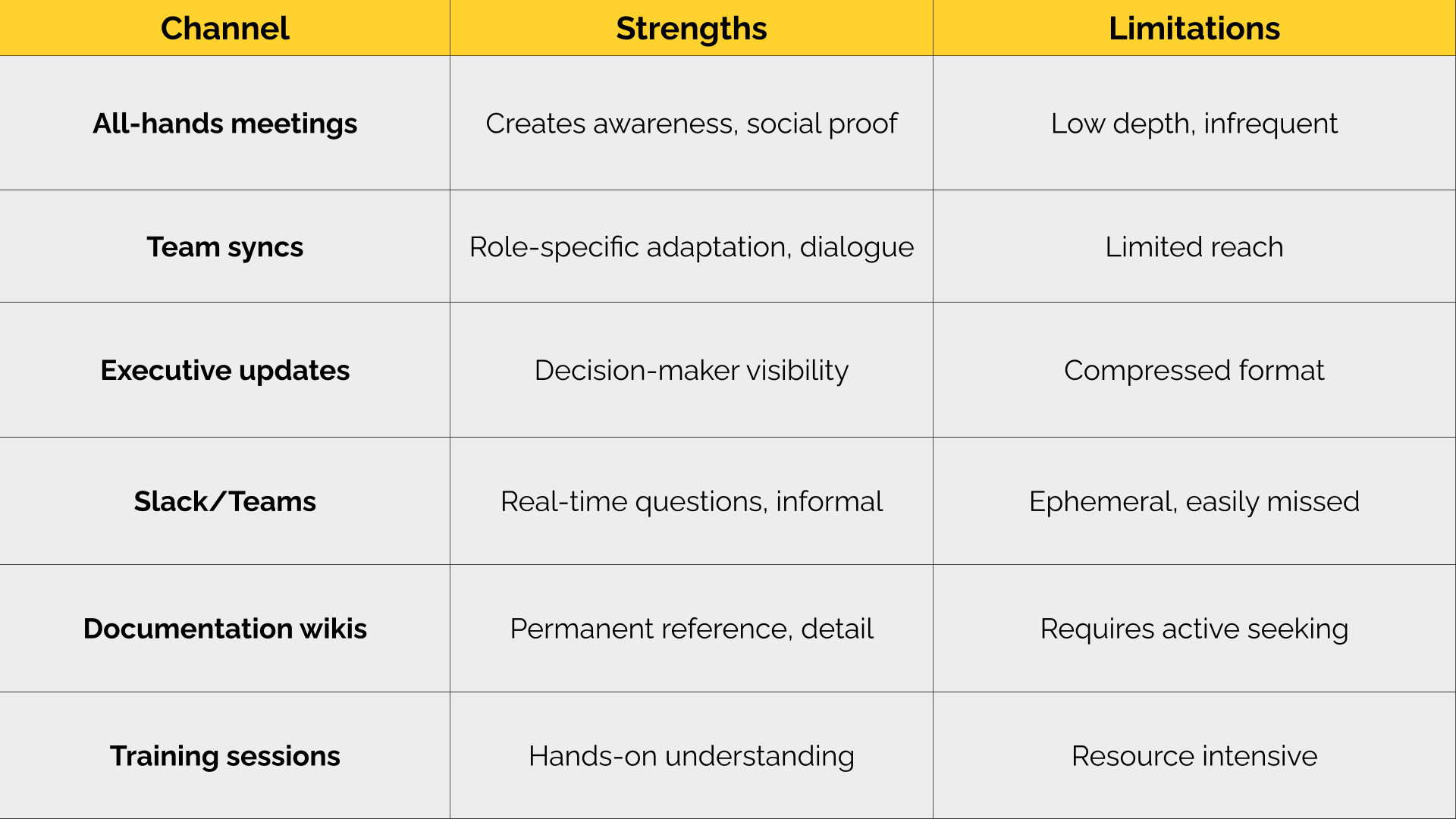
For high-priority initiatives, use multiple channels with adapted content. An all-hands mention creates awareness. A detailed document provides depth. Slack discussions allow questions. Team-level sessions enable role-specific adaptation. The redundancy is intentional.
Translating Privacy Value to Business Value
Privacy teams often communicate in privacy terms. DSAR automation. Consent rate optimization. Compliance risk reduction. These are the right concepts for the work, but they're the wrong framing for executive audiences.
Translate to business metrics that your leadership already tracks. What does the CFO care about? Margin, revenue, cost reduction. What does the COO care about? Operational efficiency, scalability, resource allocation. What does the CMO care about? Customer lifetime value, engagement, brand trust.
A DSR automation project becomes "reducing manual processing costs by X percent" or "decreasing fulfillment time to improve customer satisfaction scores." Consent optimization becomes "increasing email deliverability rates" or "improving marketing ROI through better targeting data."
Open your CEO's latest strategy presentation. Identify the top three priorities. Frame your privacy initiatives as contributions to those priorities. The substance doesn't change. The framing changes everything.
Building Cross-Functional Relationships
Privacy touches legal, IT, marketing, HR, product, and operations. Each functional area has different priorities, different languages, and different perspectives on what privacy means for their work.
The relationship-building happens before you need something. When you approach a team only when you need their resources or cooperation, you're starting from zero. When you've invested in understanding their challenges and contributed to their priorities, requests land differently.
Regular touchpoints with stakeholder teams create ongoing dialogue rather than transactional interactions. Understand what marketing is trying to accomplish this quarter. Know what IT is dealing with in their infrastructure modernization. Be aware of the legal team's priority litigation matters.
When your privacy initiative advances their objectives, they become allies rather than obstacles.
AI as a Communication Amplifier
The volume of communication required to drive organizational change exceeds what most leaders can personally produce. AI tools can accelerate content creation for internal communications.
The approach that preserves your voice while scaling output:
Write the core message yourself with the strategic framing you want to convey. Without this, you allow AI systems to use their voice and tone instead of yours.
Feed AI your draft along with context about the target audience and channel.
Generate variations for different formats: a concise version for Slack, an expanded version for documentation, a presentation-friendly version for team meetings.
Adapt for different audiences: translate the same substance into language that resonates with technical teams, executives, or operational staff.
Apply final polish yourself to ensure tone, strategic emphasis, and nuance reflect your judgment.
This doesn't mean outsourcing judgment. The strategic direction remains yours. But the production mechanics of creating multiple assets from a single strategic message can accelerate dramatically. AI assistance removes the production constraint that limits what you can realistically communicate.
Prioritization When Everything Is Urgent
Privacy teams face competing demands. Regulatory deadlines, incident response, ongoing operations, strategic initiatives, and stakeholder requests all compete for attention. The urgent consistently displaces the important.
Alignment to executive priorities provides a prioritization framework. When something connects to what leadership has publicly committed to, it deserves more attention than activities without that connection. This isn't politics. It's recognition that resource allocation follows strategic priority.
Time blocking protects focus. Dedicated time for strategic initiatives, protected from meeting interruption, generates disproportionate progress. The urgent can wait an hour. The important benefits from sustained attention.
The organizations that successfully drive privacy transformation aren't the ones with the most sophisticated strategies. They're the ones that communicate those strategies persistently, across multiple channels, in business language their audiences understand.
Working on a privacy initiative that needs organizational support? Talk to our team at FLLR Consulting to learn more.
Reach out today to book a consultation.