
Championship Lessons for Building Privacy Teams

Guest Contributor
Mike Irr
Founder, Alpha Athletic Development
Mike Irr is the driving force behind Alpha Athletic Development, bringing thirteen seasons of NBA experience as a head strength & conditioning coach. Mike spent three years with the Golden State Warriors (2015-2018), winning two NBA Championships and helping maintain player health during their historic 73-win season, along with experience with Bulls, Bobcats (now Hornets), and Hawks.
Now with Alpha Athletic Development, Mike delivers unparalleled training programs for athletes and active adults looking to surpass their limits.
What can NBA championship teams teach privacy leaders about building high-performing organizations? More than you might expect. The dynamics of bringing together talented individuals toward a common objective translate directly to enterprise team building.
The lessons here come from Mike Irr, who served as strength and conditioning coach for the Golden State Warriors during their 73-win season and consecutive title runs, and who kept the Atlanta Hawks among the least-injured teams in the league. The principles that work for elite athletes work for privacy programs.
Alignment Before Everything
Five players on the court, all moving toward the same objective, each understanding their role and how it contributes to the collective goal. That's the foundation of championship basketball. Teams with more individual talent but less alignment consistently underperform teams that play together.
The parallel to privacy teams is direct. You may have talented lawyers, skilled technologists, experienced compliance professionals, and capable project managers. If they're not aligned on priorities, operating with shared understanding of goals, and clear on how their work connects to the broader program, individual talent doesn't translate to team performance.
Alignment starts with vision that comes from leadership. What are we trying to accomplish? What does success look like? How does each person's work contribute? These questions need explicit answers, communicated repeatedly until the team can articulate them without prompting.
The organizations where privacy programs thrive have leaders who take responsibility for creating and maintaining alignment. They don't assume that hiring good people means those people will automatically coordinate effectively. They invest in the communication and relationship-building that keeps everyone moving in the same direction.
Talent in the Right Roles
The Warriors' championship runs featured superstars willing to be selfless: Curry, Thompson, Green, Durant. Each capable of dominating individually. Each willing to defer to teammates in situations where that created better outcomes. And surrounding them, veterans like Andre Iguodala and David West who understood their specific contributions and executed within their roles.
Privacy teams need both: exceptional individual contributors and people who understand how their piece fits into the larger picture. The challenge comes when talented individuals want to operate outside their optimal contribution zone.
The data protection lawyer who wants to lead technology decisions. The security engineer who wants to own policy development. The project manager who wants to make substantive compliance calls. Individual ambition is healthy, but teams function when people excel at what they're best suited for.
Leadership responsibility here involves honest role clarity. What does this position actually require? What capabilities is this person genuinely strong at? Where there's mismatch, it needs addressing through development, repositioning, or honest conversation about fit.
Balancing Authority and Empathy
Effective leadership requires a dichotomy: the willingness to hold standards firmly while understanding individual circumstances deeply. Too much authority without empathy creates fear-based compliance that doesn't generate genuine performance. Too much empathy without authority creates lack of accountability and declining standards.
When a team member underperforms, the question isn't just "how do we fix the performance?" It's also "what's driving the underperformance?" Someone going through personal difficulty needs different handling than someone who lacks capability or someone who lacks motivation. The authority to demand performance and the empathy to understand context need to coexist.
In privacy teams specifically, this balance matters during high-pressure periods: regulatory deadlines, breach response, system implementations. The team needs to perform at peak levels. Individual team members are human beings with lives outside work. Leaders who demand without understanding burn out their teams. Leaders who accommodate without demanding miss critical objectives.
Building From the Top
The Warriors had the best shooter of all time in Steph Curry, arguably the second-best in Klay Thompson, and a Hall of Famer in Kevin Durant during their championship runs. But elite talent alone doesn't guarantee championships. What made it work was alignment across levels: a general manager with a vision for how the team would play, a coach who could translate that vision into game plans, and star players who bought into the system rather than demanding it bend to them.
Privacy programs follow similar hierarchy:
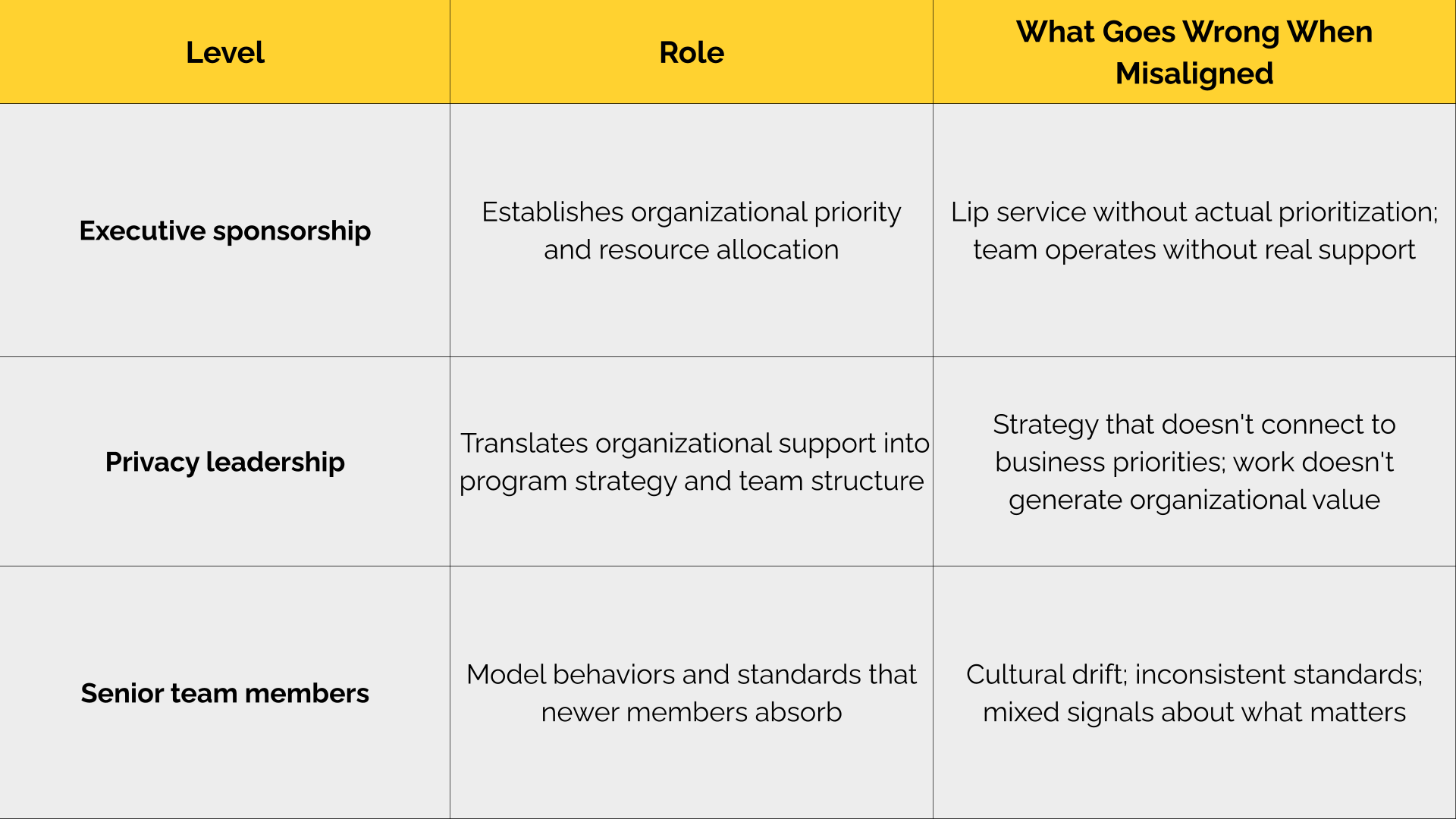
When there's misalignment at the top, it cascades through the organization. The lesson: get the top levels right first. Then the rest of the team has a foundation to build on.
Sustainable Performance Over Heroic Effort
Elite athletes don't win championships through unsustainable effort. They win through consistent, sustainable performance over long seasons, peaking at the right moments without burning out before they matter most.
Privacy teams face similar demands. Regulatory deadlines create crunch periods. Breach response requires intense focus. Major implementations demand extra hours. But teams that operate in crisis mode continuously don't perform when the moments that truly matter arrive.
Building sustainable performance requires investment in:
Workload distribution that prevents single points of failure and spreads critical responsibilities across the team
Development of bench strength so the same people don't carry every critical activity and the team has capacity when someone is unavailable
Recognition that long-term program success matters more than any single initiative, and that protecting team health is a leadership responsibility
The organizations with the healthiest privacy cultures are the ones that protect their teams from chronic overwork while building capability for when peak effort is genuinely required.
Communication That Connects
Every principle here depends on effective communication. Vision needs articulation. Role clarity needs explicit conversation. Authority and empathy both require the ability to have difficult discussions. Alignment requires ongoing dialogue, not a single announcement.
Leaders who struggle with communication struggle with everything else. The vision they hold in their heads doesn't transfer to the team. The feedback they intend to give never lands clearly. The alignment they assume exists isn't actually present.
The investment in communication capability, whether through coaching, practice, or deliberate skill development, pays returns across every other leadership dimension.
Building or developing your privacy team? Reach out to our team at FLLR Consulting to help you plan your roadmap for the year.
Book a consultation today.